OUR MISSION STATEMENT
We, the members of the Holy Rosary Parish family, are the living sign of Christ’s Presence, reconciling life, light, hopefulness, and healing within our community. Through the power of the Holy Spirit, we seek to realize the full potential of our creative energies to be about the work of God in our commitment to the Lord, each other, the Church and our world. We are a community sharing responsibility and celebration. We seek to reflect the love of Jesus in such a way that we burn with desire to be at one with Him. We pray that we are open to hear an understand the good news, while we reach out to those who have not heard it. We come together as one, sharing the Word, the Eucharist, and the Spirit which is our Gift from God.
October: The Month of the Holy Rosary
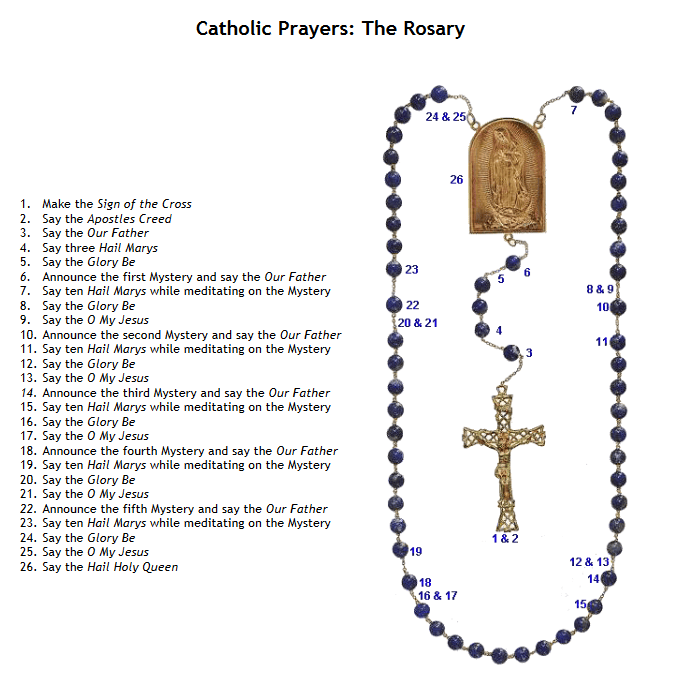
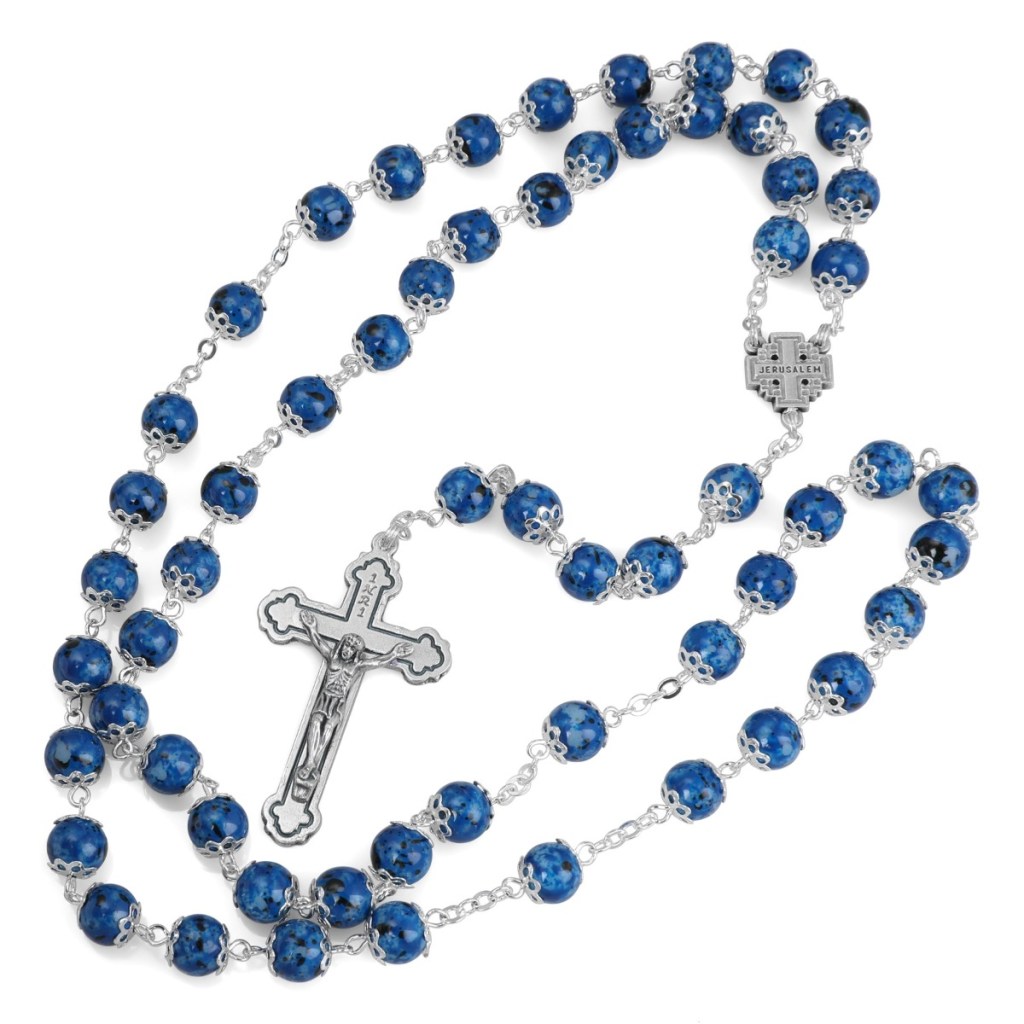
The month of October is dedicated to the Holy Rosary. No form of extra-liturgical devotion to Mary is more widely practiced among the faithful or found by them to be more satisfyingly complete than the Rosary, which has come to be regarded as the very badge of Catholic piety. No form of extra-liturgical devotion to Mary has been recommended more warmly or frequently by the Popes. With perhaps two exceptions, all the Sovereign Pontiffs from Sixtus IV in 1478 down to John XXIII, especially Leo XIII (in 23 documents, ten of them encyclicals entirely on the Rosary) and his successors, have extolled this form of prayer, which has been the favorite, moreover, of such saints as Teresa of Avila, Francis de Sales, Louis de Montfort, Alphonsus Liguori, Don Bosco, Bernadette, and many more.
The authentic Rosary is a happy combination of vocal and mental prayer, each of which is essential to the devotion. It is incorrect to say that meditation is “the very essence of the Rosary devotion,” for vocal recitation of the prayers is also of the essence. Meditation is, of course, the nobler element, the “soul,” while vocal prayer is the “body” of the devotion. The Rosary, Pope Leo XIII declared, “is composed of two parts, distinct but inseparable — the meditation on the mysteries and the recitation of the prayers. It is thus a kind of prayer that requires not only some raising of the soul to God, but also a particular and explicit attention” (Incunda semper). Hence, as Pope Pius XI stated, they err “who consider this devotion merely a boresome formula repeated with monotonous and singsong intonation” (Ingravescentibus malis). Moreover, as Pius XI put it, “both piety and love, although always breathing forth the same words, do not, however, repeat the same thing, but they fervently express something ever new which the loving heart always sends forth.” And finally, in the words of Pius XII, “the recitation of identical formulas, repeated so many times, rather than rendering the prayer sterile and boring, has on the contrary the admirable quality of infusing confidence in him who prays, and brings to bear a gentle compulsion on the motherly heart of Mary (Ingravescentibus malis).
Pope Benedict XVI in an address at the Basilica of St. Mary Major where he prayed the rosary with the faithful said:
“Today, together we confirm that the Holy Rosary is not a pious practice banished to the past, like prayers of other times thought of with nostalgia. Instead, the Rosary is experiencing a new Springtime. Without a doubt, this is one of the most eloquent signs of love that the young generation nourish for Jesus and his Mother, Mary. In the current world, so dispersive, this prayer helps to put Christ at the centre, as the Virgin did, who meditated within all that was said about her Son, and also what he did and said. When reciting the Rosary, the important and meaningful moments of salvation history are relived. The various steps of Christ’s mission are traced. With Mary the heart is oriented toward the mystery of Jesus. Christ is put at the centre of our life, of our time, of our city, through the contemplation and meditation of his holy mysteries of joy, light, sorrow and glory. May Mary help us to welcome within ourselves the grace emanating from these mysteries, so that through us we can “water” society, beginning with our daily relationships, and purifying them from so many negative forces, thus opening them to the newness of God. The Rosary, when it is prayed in an authentic way, not mechanical and superficial but profoundly, it brings, in fact, peace and reconciliation. It contains within itself the healing power of the Most Holy Name of Jesus, invoked with faith and love at the centre of each “Hail Mary”.
Until about the 15th century hundreds of mysteries were part of the Rosary devotion then the 15 mysteries that we know today were definitively fixed as “the Mysteries of the Rosary.” Pope John Paul II, in his encyclical, Rosarium Virginis Mariae, in 2002 added the five Luminous Mysteries.
Through the meditations of the complete Rosary one recalls and has impressed on his mind, the Popes tell us, “the chief mysteries of the Christian religion,” “the mysteries of our Redemption,” “the great mysteries of Jesus and His Mother united in joys, sorrows, and triumphs.” The twenty mysteries are divided into four equal groups, known as “The Joyful,” “The Sorrowful,” “The Glorious,” and “The Luminous Mysteries.”
https://www.catholicculture.org/culture/liturgicalyear/overviews/months/10_1.cfm